Posted in Roofing Guides & Cost Blog · September 13, 2026
The short answer
Judge a roofing contractor Tulsa OK homeowners actually recommend on three things you can verify in an afternoon: an Oklahoma roofing registration number, a certificate of insurance showing at least $500,000 in general liability plus workers’ compensation, and a written, itemized scope of work. Yard signs, door hangers and a truck with out-of-state plates tell you nothing about any of the three.
That bias toward verification is not paranoia in Tulsa County. Our dataset rates the metro Extreme for hail risk, with roughly 5.4 logged hail events a year, a 115 mph design wind speed, 19 tornado events and eight FEMA disaster declarations since 2010 — and the average tracked Tulsa roof is already 20 years old on a 38-year-old house. Storm season reliably brings out-of-state crews that knock doors, collect deposits and leave town.
What follows is the checklist we walk Tulsa homeowners through before they hire a roofing contractor Tulsa OK: what to verify, how to read a Tulsa estimate line by line, where a contractor genuinely earns their fee on an insurance claim, and the questions that separate a real roofer from a storm chaser.
Why Tulsa roofs fail earlier than the national average
Tulsa sits in one of the most hail-exposed metros in the country. Of the 114 Oklahoma cities in our dataset, 74% land in Extreme or High hail-risk bands, and Tulsa County is Extreme with about 5.4 logged hail events per year. Statewide, hail has been reported in every calendar month since 2010, alongside 974 tornado events and 439 FEMA disaster declarations. This is not a market where a roof gets to age quietly.
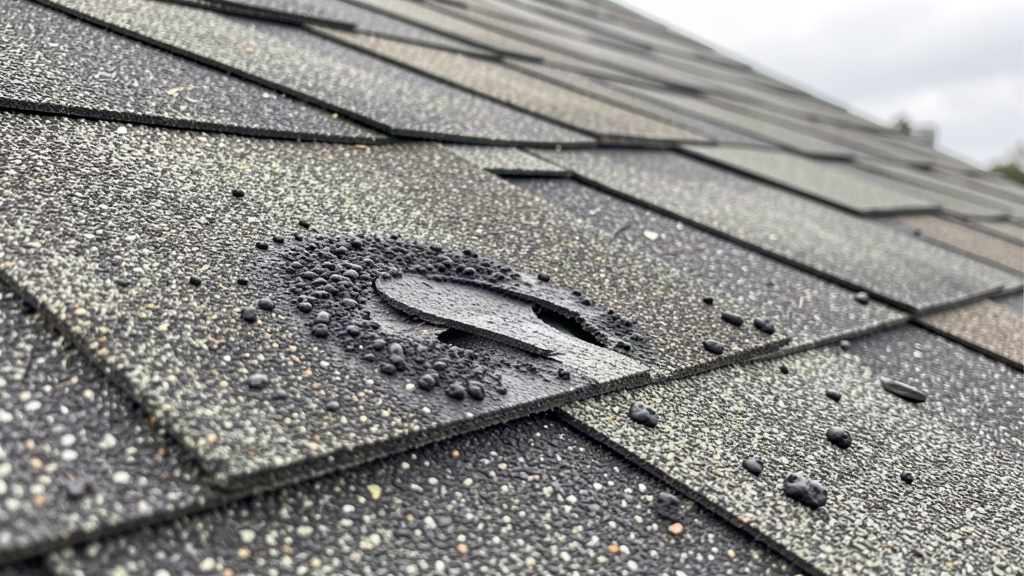
Three stresses do most of the damage:
- Hail — impact bruises crush the shingle mat and knock granules loose, exposing asphalt to UV. On the ground it usually looks fine; in a test square it does not.
- Wind — the design wind speed here is 115 mph. Uplift starts at edges, ridges and hips, which is why nailing pattern, sealed starter courses and ridge detailing matter more than shingle brand loyalty.
- Heat and freeze-thaw — mid-90s summer air pushes dark roof surfaces past 150°F, accelerating aging, while winter freeze-thaw cycles at eaves and valleys are what make ice and water shield non-negotiable in Tulsa.
Practical service life in this climate: 3-tab asphalt shingles 15–20 years, architectural shingles 20–30, and metal or standing seam 40–70. With the average tracked Tulsa roof at 20 years, a large share of the metro is sitting at the end of the architectural window — the point where a repair decision and a replacement decision compete, and where a roofing contractor Tulsa homeowners can verify is worth more than the one with the lowest number. Our Oklahoma roof cost calculator is the fastest way to see which side of that line your house is on.
What to verify before you hire a roofing contractor Tulsa OK
Every check below takes minutes, and each one closes off a way to get burned. Do them in this order, before any deposit changes hands.
- Registration. Oklahoma roofing contractors are required to be registered with the Oklahoma Construction Industries Board (CIB). Ask for the registration number in writing and verify it on the CIB site yourself. Registration is also what allows a contractor to pull your permit and enforce a warranty.
- Insurance, verified by phone. Residential roofing work in Oklahoma carries a $500,000 general liability minimum, but the coverage homeowners forget is workers’ compensation. If an uninsured laborer is injured on your property, the claim can follow your homeowner policy. Ask for the certificate, then call the agent named on it and confirm the dates and limits are current.
- Permits. The City of Tulsa Permit Center requires a permit for reroofing, and our dataset puts the average Tulsa permit fee near $115. A contractor who offers to skip the permit is telling you they would rather not be inspected.
- Local footprint. A Tulsa address, recent jobs you can drive past, a BBB profile and a steady 12-month review history. Storm-chasers usually show a single-season spike of reviews and an address that resolves to a mailbox.
- Warranty in writing. Workmanship coverage — typically 5–10 years — is the contractor’s own promise. The manufacturer’s 25–50 year material warranty only upgrades to the enhanced tier when the installer is certified for that brand. Ask whether it transfers if you sell the house.
Equally important is what you should not weigh: the lowest bid on its own, a “we’re working in your neighborhood today” discount that expires this afternoon, or any pricing that is built around what your insurance will pay rather than what your roof needs.
How to read a Tulsa roofing estimate line by line
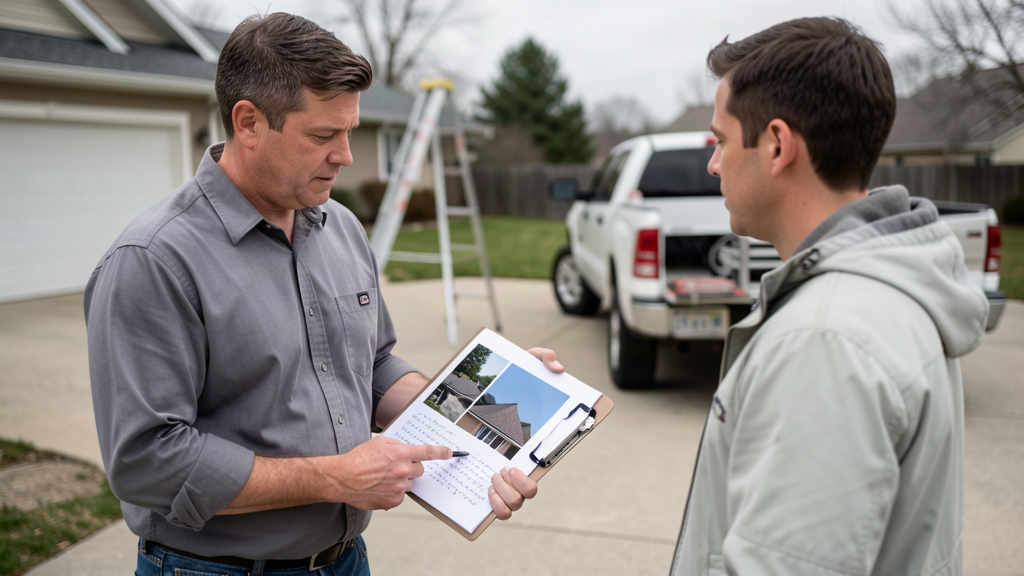
A roofing contractor Tulsa homeowners end up recommending is usually the one whose estimate was the most specific, not the cheapest. A usable estimate itemizes materials by brand, type and quantity rather than describing them; it separates labor from materials, states how many layers are being removed, names the underlayment, and carries an allowance for decking that turns out to be rotten once the tear-off is done. It also lists the permit, the dumpster and the start and completion dates with a weather clause.
For cost context in the Tulsa market, our dataset puts architectural asphalt shingle replacement on a 2,000-square-foot roof at about $8,200 installed, and standing seam metal at about $17,500. Nationally, 2026 replacement averages around $9,500 with a range of $5,800–$46,000 depending on size, pitch, layers removed and material, with labor at $5–8 per square foot. Repair is a different order of magnitude: a leak repair typically runs $150–$450.
Line items worth demanding in writing on a Tulsa roof:
- Class 4 impact-resistant (UL 2218 tested) shingles — commonly worth a 15–35% insurance premium discount in hail-exposed Oklahoma, which changes the payback math on the upgrade.
- The underlayment spec. Our Tulsa dataset recommends a Class 4 impact-resistant synthetic underlayment with ice and water shield at eaves, valleys and penetrations.
- A decking allowance priced per sheet or per square, so rotten sheathing is a line item and not a mid-job negotiation.
- Balanced ventilation — intake at the soffits, exhaust at the ridge — plus drip edge, step and counter flashing at chimney and sidewalls.
- Disposal, the permit fee, and a magnetic sweep plus walkthrough at completion.
On payment: a deposit of 10–25% is normal in Tulsa, full payment up front is not. Hold the final payment until the walkthrough is done, the documentation is handed over and, on larger jobs, suppliers have provided lien waivers.
Storm damage, insurance claims and where the contractor earns the fee
After hail or wind, the sequence matters more than the speed. Document what you can see from the ground first, then get the roof inspected, then file. Insurers work from the condition of the roof at the time of loss, and our guide to getting a roof inspected after a hail storm walks through the 24–72 hour window, while roof damage warning signs you can see from the ground covers what to photograph before anyone climbs up. Report the claim within 48–72 hours.
Most storm inspections are free because they feed a repair or claim conversation. A paid diagnostic inspection — useful when you want an independent written condition report — averages $252 nationally, with a typical range of $150–$500 (see what a roof inspection costs in 2026).
A roofing contractor Tulsa OK homeowners shortlist should bring a specific set of things to a claim: moisture meters and thermal imaging to find hidden water, chalk-marked test squares that show hail bruising on shingle mats, dated photo documentation, measurements, and code-driven line items such as drip edge, ice and water shield and balanced ventilation. They meet the adjuster on site, and they request a re-inspection when a line item is missed. That is the work behind storm damage roof inspection in Tulsa, storm damage roof repair in Tulsa and hail damage roof repair in Tulsa.
The Oklahoma deductible rule every Tulsa homeowner should know. Under 59 O.S. § 1151.30, a roofing contractor may not advertise or promise to pay, waive or rebate any part of your insurance deductible, or compensate you for services, as an inducement to win the job. The consequence is harsher than a fine: if a contractor violates the rule, the insurer is not obligated to consider that contractor’s estimate at all. Contractors are also required to hand you written notice of the rule with the initial estimate. So when someone offers to “cover your deductible,” they are not discounting — they are putting the claim itself at risk.
If a storm has already opened the roof, stop the water first and argue about paperwork afterward. An active leak that soaks insulation and drywall adds an average of about $3,865 in interior damage repairs on top of the roof work, so emergency roof repair in Tulsa or a tarp is money well spent.
The questions that separate a real contractor from a storm chaser
Ask these of every roofing contractor Tulsa OK homeowners consider. The answers themselves matter less than whether they arrive quickly, in writing.
- What is your Oklahoma roofing registration number, and who at your company holds it?
- Can I see your certificate of insurance, and what number do I call to verify it?
- Will you pull the permit through the City of Tulsa Permit Center, and is the fee in this estimate?
- Who is physically on my roof — your employees, or subcontracted crews?
- What is the decking allowance if the sheathing is rotten?
- Which underlayment and which shingle brand and line are you installing, and are you certified for it?
- How long is your workmanship warranty, and is it transferable?
- What is the payment schedule, and what has to happen before I pay the balance?
- What is the start date and the completion window, and what happens if it rains?
- Who is my single point of contact once work starts?
Red flags, in roughly the order they cost homeowners money: full payment requested up front; an offer to waive or absorb the deductible; no Oklahoma registration number or a certificate of insurance that nobody will verify; no written scope, only a total price; a local phone number that forwards to another state; and a pitch that ties your scope to “what insurance will cover” rather than what the roof needs. Any one of those is reason enough to call the next contractor.
From signed contract to final sweep in Tulsa
Most residential replacements here take one to three days depending on size, pitch and how much decking has to be replaced. Expect materials staged in the driveway the day before, a tear-off that is by far the loudest part of the job, then underlayment, drip edge, flashing, shingles and ridge ventilation in sequence.
Before the crew arrives: clear the driveway and garage so trucks and the dumpster have room, move vehicles, take down wall hangings in the rooms directly under the roof, and shift grills, furniture and decorations at least 15 feet from the foundation. Keep pets inside. Expect ladder traffic around the perimeter and a compressor running most of the day.
Season timing is worth planning around. Asphalt shingles bond properly at 40°F or warmer, when seal strips can activate — which is the reason roofing in cold weather is a scheduling question rather than a hard no in Oklahoma. Late fall through early spring is easier to book and easier to price than the week after a hail event, when every crew in the metro is triple-booked.
The closeout is where a roofing contractor Tulsa homeowners still recommend a year later proves it. You should get a walkthrough of the finished roof, a photo report, the manufacturer material spec and both warranty documents, gutters checked and cleared, and at least one pass with a magnetic sweeper for nails. Then the maintenance clock starts: twice-a-year inspections plus a post-storm check, using a 20-point roof inspection checklist, gutters cleaned at least twice a year, and small flashing or seal fixes handled within weeks rather than seasons. Repairs delayed to the next storm season are how a $200 detail becomes a $3,000 repair — the pattern we track in the Oklahoma roof cost and storm data index.
Three documents settle this: an Oklahoma roofing registration number you verified yourself, an insurance certificate with an agent who answers the phone, and a written scope that names brands, quantities, underlayment, decking allowance and payment terms. Tulsa hail is relentless enough that the cheap version of any one of those three costs more than the roof. If you want a licensed local contractor to inspect your roof and put the scope in writing, that inspection is free.
Frequently asked questions
How do I check whether a roofing contractor in Tulsa is licensed?
Oklahoma roofing contractors must be registered with the Oklahoma Construction Industries Board (CIB). Ask for the registration number in writing, verify it on the CIB website, then confirm general liability coverage (a $500,000 minimum for residential work) and workers’ compensation by calling the insurance agent named on the certificate. Permits are pulled through the City of Tulsa Permit Center, and the permit record itself shows who is doing the work.
How much does a new roof cost in Tulsa in 2026?
For a typical 2,000-square-foot roof, our Tulsa dataset puts architectural asphalt shingle replacement at about $8,200 installed and standing seam metal at about $17,500. Nationally, 2026 roof replacement averages around $9,500, with a range from $5,800 to $46,000 depending on size, pitch, layers removed and material. Add the City of Tulsa roofing permit, which averages about $115.
Do Tulsa roofing contractors offer free roof inspections?
Most do, especially after hail or wind events, because a storm inspection feeds a repair or claim conversation. A paid diagnostic inspection, used when you want an independent written condition report, averages $252 nationally with a typical range of $150 to $500.
What should I do in the first 72 hours after a hailstorm in Tulsa?
Photograph and date whatever you can see from the ground, keep any hail-damaged gutters or downspouts as evidence, tarp any active leak, and get a professional inspection before or while the claim is open. Report the claim to your insurer within 48 to 72 hours, and do not sign anything with a contractor who knocked on your door until you have verified their Oklahoma registration and insurance.
What is the biggest red flag when hiring a roofing contractor in Tulsa?
A request for full payment up front, a promise to cover or waive your insurance deductible (prohibited by Oklahoma law and enough for an insurer to disregard that contractor’s estimate), no verifiable Oklahoma registration or insurance certificate, and no written scope of work. Any one of those is a reason to walk.
Book a free roof inspection in Tulsa
LocalRoofOps connects Tulsa homeowners with licensed local contractors for free roof inspections and written, itemized estimates. No pressure and no deductible gimmicks — just a documented scope you can compare against any other bid.
Sources
- LocalRoofOps Oklahoma roofing dataset — 114 cities: Tulsa County rated Extreme hail risk (5.4 logged hail events a year), 115 mph design wind zone, 19 tornado events and 8 FEMA disaster declarations since 2010, average permit fee about $115 (Oklahoma cost & storm data index).
- Oklahoma Statutes 59 O.S. § 1151.30 — roofing contractors prohibited from advertising, promising or paying any part of an insurance deductible (added Laws 2022, c. 331; amended 2025).
- Oklahoma Construction Industries Board — roofing contractor registration and insurance requirements.
- City of Tulsa Permit Center — reroofing permit requirements and fee schedule.
- Angi (2026) — roof inspection averages $252 with a range of $150–$500, and national roof replacement cost data.
- GAF — asphalt shingle installation temperature guidance (40°F minimum for seal-strip bonding).
- UL 2218 — impact-resistance classification; Class 4 ratings used by insurers for hail premium discounts.
Last reviewed: September 13, 2026. Figures are 2026 national averages or regional dataset values, per sources above. See data & methodology for how city-level numbers are built.